
Last Updated: 16th January 2026
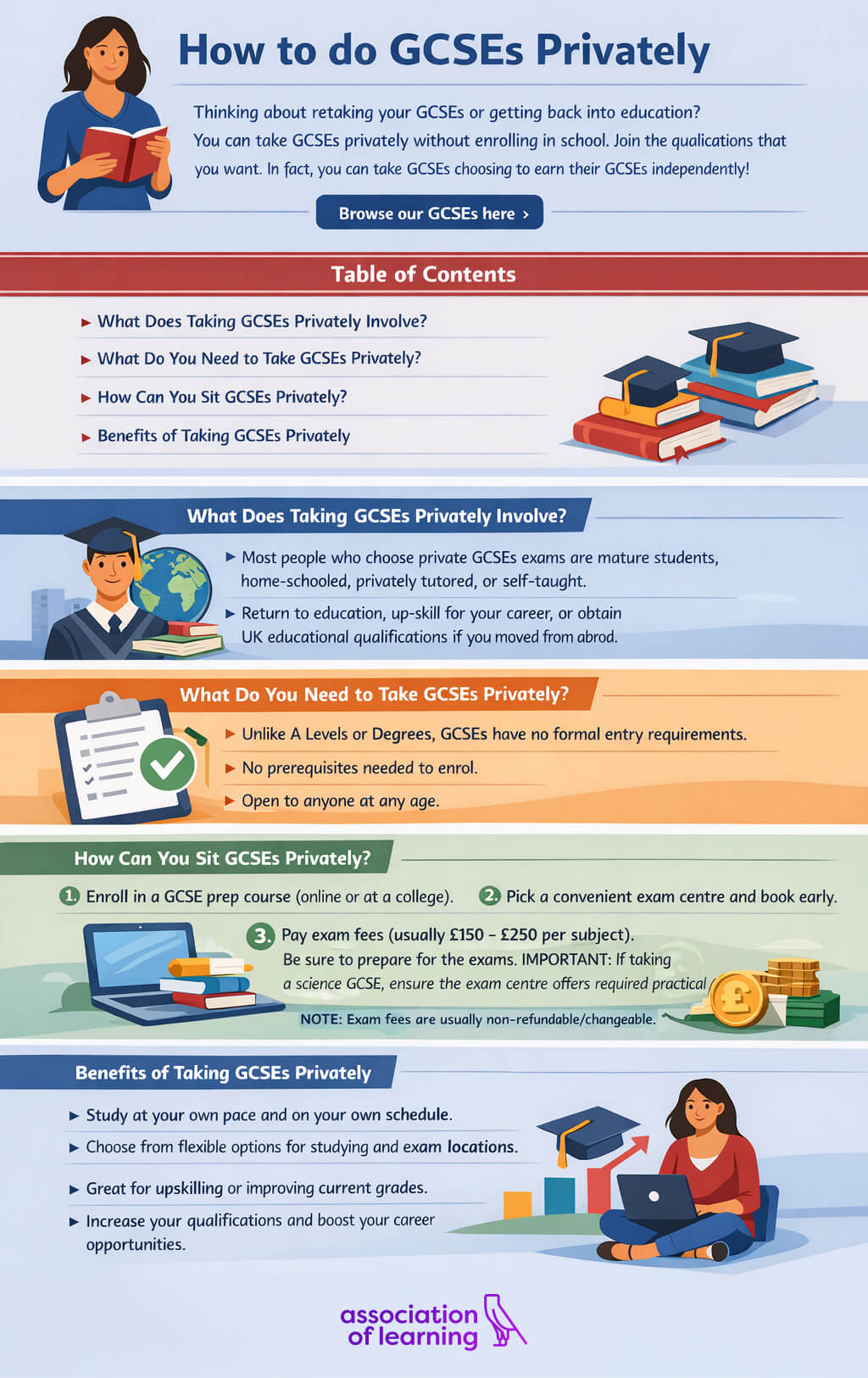
Are you thinking about retaking your GCSEs or want to get back into education? Well, you don’t have to re-enrol or go to college to get the qualifications that you want. In fact, you can take GCSEs privately and join the tens of thousands of adults who have chosen to take their GCSEs privately.
You can browse our GCSEs here.
Table of Contents
- What Does Taking GCSEs Privately Involve?
- What Do You Need to Take GCSEs Privately?
- How Can You Sit GCSEs Privately?
- Benefits of Taking GCSEs Privately
What Does Taking GCSEs Privately Involve?
What does taking GCSEs privately involve? Most people who choose to do private examinations are mature students; however, this definition can also be applied to those who have been home-schooled, privately tutored, or who are self-taught and want to officially earn their GCSEs.
In turn, you may choose to take your exams privately if you’re wanting to return to education, up-skill for your career, or if you’re from another country and they could not provide you with an equivalent educational qualification.
What Do You Need to Take GCSEs Privately?
Unlike most qualifications, i.e. A Levels, Degrees, etc. where you can only enrol if you’ve got enough points, GCSEs themselves have no formal entry requirements or educational prerequisites.
Instead, teenagers between the ages of 14 to 16 are expected to take these upon completion of their secondary school education. In truth, they spend years preparing for these exams and are taught how to handle them in their syllabus.
Yet, this doesn’t mean you have to be in secondary school in order to take them.
Can you take GCSEs privately without being enrolled in school?
Yes, anyone can take GCSEs and harness these qualifications to improve their circumstances.
How Can You Sit GCSEs Privately?
Can you sit GCSEs privately without being tied to a school? Yes, you can. Here’s how:
- Book onto a GCSE preparation course – you can do this through online courses or by enrolling with a college.
- Pick where you want to sit your exam – you should have a choice of centres around you. However, you may find that some centres will only let you sit certain subjects, so you may have to go to more than one. Important: If you’re taking a science GCSE, check whether your exam centre provides practical assessments, as these are compulsory.
- Find out when they will take place so you can get your spot booked in advance. Exam dates are set at a national level, so you will discover that they can quickly fill up. We suggest booking at least six months in advance.
- If you cannot find a time or location online that works for you, call the exam boards directly as sometimes there are exams that are scheduled which aren’t listed online. Similarly, you can call local colleges/schools to see if they will allow you to sit the GCSEs privately on-site.
- Pay your fees – as you are taking GCSEs privately, these exams won’t be free, and you’ll be expected to pay for each one at the time of booking. Costs vary by centre and subject, but expect to pay between £150 – £250 per GCSE. NOTE: they aren’t usually refundable/changeable, so make sure you book the correct time and date.
- Make sure you have all the right information to hand – e.g. your name, date of birth, address, phone number, Unique Candidate Identifier (UCI), and the correct exam code for the course.
- Ensure that you arrive at the exam on time and that you have brought the essentials with you, e.g. photo ID, black pens, pencils, rubbers, sharpeners, transparent pencil case, bottle of water, a calculator, and appropriate maths equipment (if you are doing Maths GCSE).
Benefits of Taking GCSEs Privately
Upskilling or improving your current GCSE grades doesn’t have to be daunting. In fact, taking GCSEs privately is well within your grasp. Not only does it allow you to study at your own pace, but it also offers flexibility in choosing where and when to sit the exams.
If you’re interested in completing a GCSE, then why not take a look at our range of online GCSE courses? With test centres across the country, you can sit GCSEs privately and soon boost your credentials.








Comments (0)
Join the conversationCancel Reply